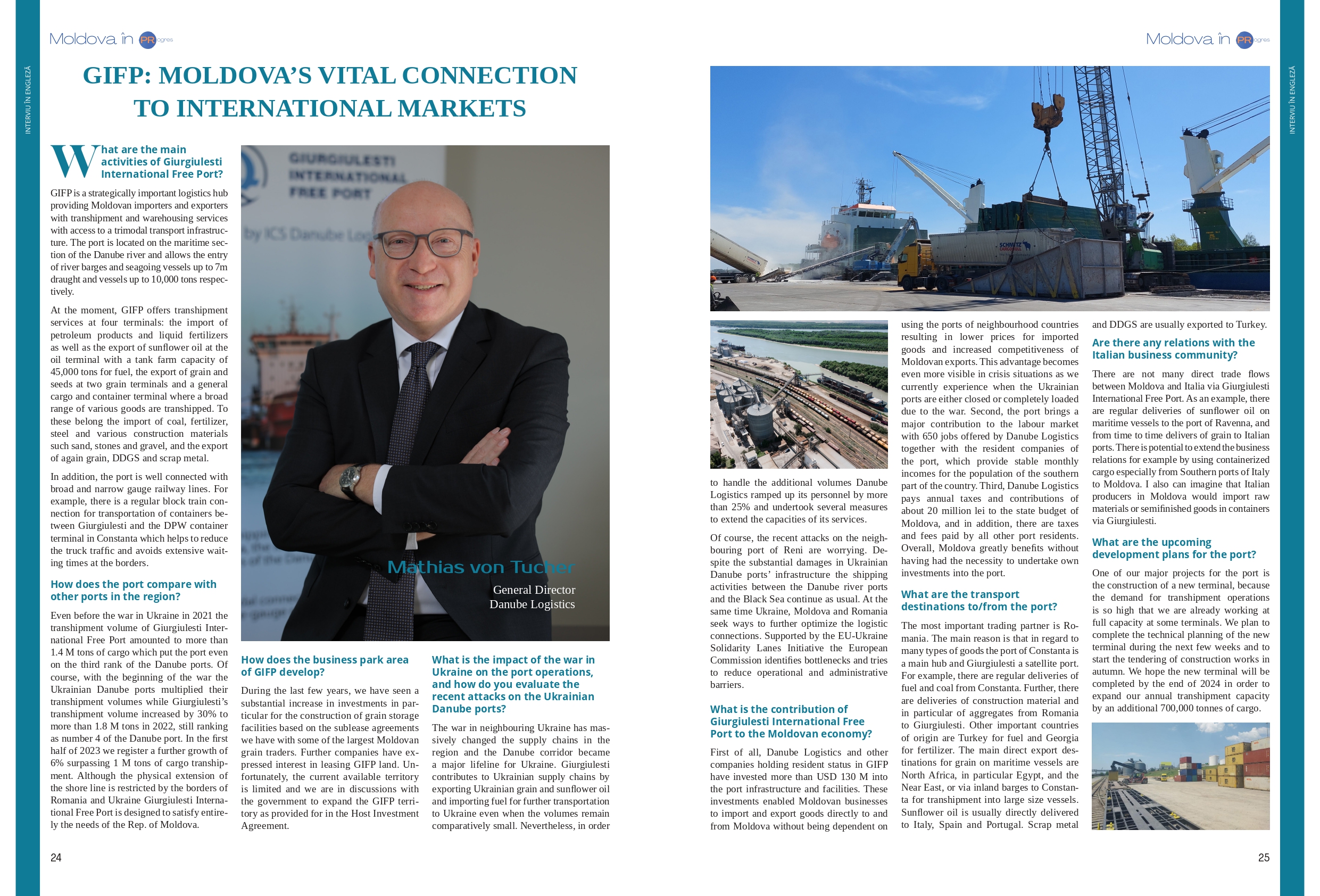
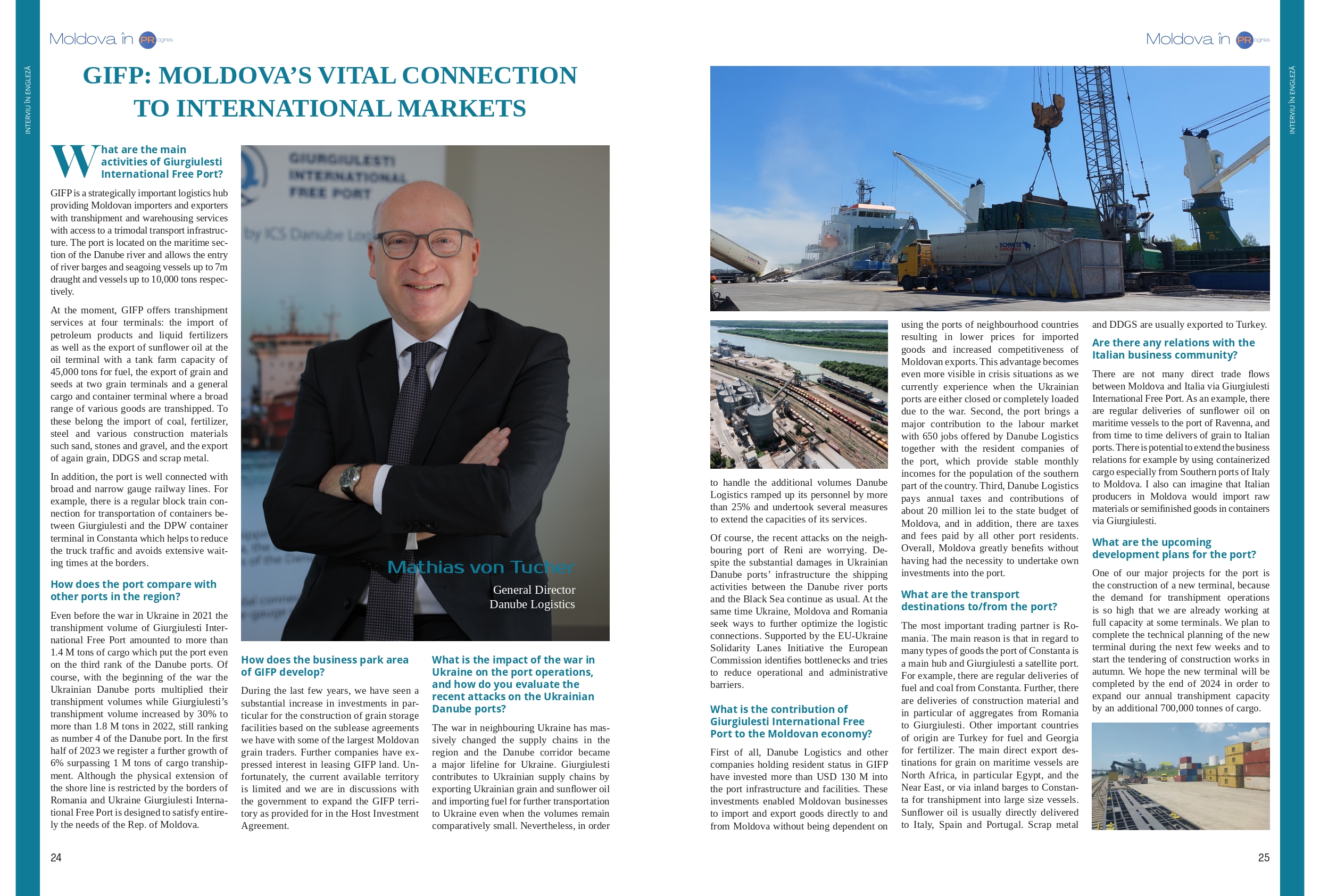
Our General Director Mathias von Tucher offered an interview for the magazine Moldova în Progres on the vital role of GIFP as a connection to international markets (published in Moldova în Progres, issue 42).
GIFP: MOLDOVA’S VITAL CONNECTION TO INTERNATIONAL MARKETS
MP: What are the main activities of Giurgiulesti International Free Port?
GIFP is a strategically important logistics hub providing Moldovan importers and exporters with transhipment and warehousing services with access to a trimodal transport infrastructure. The port is located on the maritime section of the Danube river and allows the entry of river barges and seagoing vessels up to 7 m draught and vessels up to 10,000 tons respectively.
At the moment, GIFP offers transhipment services at four terminals: the import of petroleum products and liquid fertilizers as well as the export of sunflower oil at the oil terminal with a tank farm capacity of 45,000 tons for fuel, the export of grain and seeds at two grain terminals and a general cargo and container terminal where a broad range of various goods are transhipped. To these belong the import of coal, fertilizer, steel and various construction materials such sand, stones and gravel, and the export of again grain, DDGS and scrap metal.
In addition, the port is well connected with broad and narrow gauge railway lines. For example, there is a regular block train connection for transportation of containers between Giurgiulesti and the DPW container terminal in Constanta which helps to reduce the truck traffic and avoids extensive waiting times at the borders.
MP: How does the port compare with other ports in the region?
Even before the war in Ukraine in 2021 the transhipment volume of Giurgiulesti International Free Port amounted to more than 1.4 M tons of cargo which put the port even on the third rank of the Danube ports. Of course, with the beginning of the war the Ukrainian Danube ports multiplied their transhipment volumes while Giurgiulesti’s transhipment volume increased by 30% to more than 1.8 M tons in 2022, still ranking as number 4 of the Danube port. In the first half of 2023 we register a further growth of 6% surpassing 1 M tons of cargo transhipment. Although the physical extension of the shore line is restricted by the borders of Romania and Ukraine Giurgiulesti International Free Port is designed to satisfy entirely the needs of the Rep. of Moldova.
MP: How does the business park area of GIFP develop?
During the last few years, we have seen a substantial increase in investments in particular for the construction of grain storage facilities based on the sublease agreements we have with some of the largest Moldovan grain traders. Further companies have expressed interest in leasing GIFP land. Unfortunately, the current available territory is limited and we are in discussions with the government to expand the GIFP territory as provided for in the Host Investment Agreement.
MP: What is the impact of the war in Ukraine on the port operations, and how do you evaluate the recent attacks on the Ukrainian Danube ports?
The war in neighbouring Ukraine has massively changed the supply chains in the region and the Danube corridor became a major lifeline for Ukraine Giurgiulesti contributes to Ukrainian supply chains by exporting Ukrainian grain and sunflower oil and importing fuel for further transportation to Ukraine even when the volumes remain comparatively small. Nevertheless, in order to handle the additional volumes Danube Logistics ramped up its personnel by more than 25% and undertook several measures to extend the capacities of its services.
Of course, the recent attacks on the neighbouring port of Reni are worrying. Despite the substantial damages in Ukrainian Danube ports’ infrastructure the shipping activities between the Danube river ports and the Black Sea continue as usual. At the same time Ukraine, Moldova and Romania seek ways to further optimize the logistic connections. Supported by the EU-Ukraine Solidarity Lanes Initiative the European Commission identifies bottlenecks and tries to reduce operational and administrative barriers.


 March 09, 2024 - BY Admin